


|
Facility SERVICE L.L.C. |

|
ELECTRICAL Examination & Inspection
|


|
I/R Inspections & Examinations |

|
Who should look at this page? · Maintenance Managers · Plant Engineers · Electrical Contractors · Commercial property owners/managers · Insurance companies · Systems Engineers · Third party commissioning contractors |
|
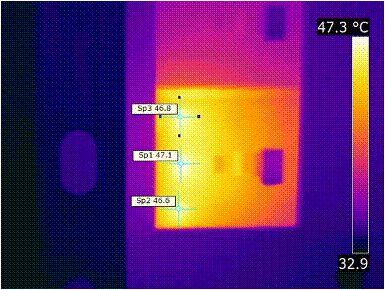
Above - A 225 amp main fusible safety switch on it’s way to imminent failure. |
|
Why implement an electrical preventative maintenance program? Heat in electrical systems indicates some sort of anomalous condition. This can be from a bad connection, undersized conductor, overloaded circuit, or type of load. Generally, when electrical failures occur, things get much worse very quickly. This will result in anything from nuisance equipment faults to all-out fires. Believe it or not—it happens far more often than you may think.
Most thermographers do not have the background or understanding of the operation of sophisticated electrical equipment. Facility SERVICE L.L.C. provides a complete analysis of suspect hot spots to better mitigate a pending problem. Experience and training that makes the difference! |
|
Watch out for that guy with the camera! There is much more to performing an electrical inspection, or examination than using the I/R “point & shoot” method. Suspect findings should always be further examined for load factor and type of load (you know - non-linear and that sort of thing). Three phase panels are examined differently than single phase panels. Electrically driven equipment must be examined specifically for the application of the apparatus. It goes on and on……..
Before hiring a thermographer, ask what other equipment, or P.P.E. will be used and in what application. Anybody can buy a camera, but understanding it’s role in the electrical inspection and examination is something requiring additional training, experience and equipment. |
|
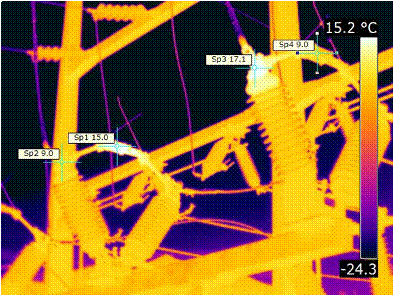
Above - A 46 KV switch group in a 138 KV - 46 KV electrical substation yard. |
|
When is hot really - you know, hot? Apparent object temperature is an indicator of an underlying condition. Wire at 75 degrees C may be just fine if the wire is temperature rated XPLE, but is in trouble if THHN. What about the lugs, or the component housing? This is where the experience comes in. Before you hire a thermographer, ask “what is NFPA 70 (NEC), table 310-16”. It’s a pass/fail question. This will give you an idea if the thermograher meets the OSHA standard for a qualified person and could possibly tell you if something is hot. |
|
Above - An electrical contactor with C-phase slightly hotter than A & B phase respectively. |
|
When do I need to remove panel covers? It depends on the predetermined inspection criteria. Heat on the surface of molded case circuit breakers is a secondary effect from the source. This is conduction and the I/R camera detects the resulting surface temperature. This is where experience really comes into the operation.
Examination of energized components is one of the major advantages of the I/R camera. However, exposure to the energized equipment requires a qualified person, proper equipment and planning. It is prudent to follow the consensus standards and recommendations from NFPA 70E, NFPA 70B and IEEE 1584.
|


|
© Facility SERVICE 2009 |
|
© Facility SERVICE 2009 |
|
© Facility SERVICE 2009 |
|
© Facility SERVICE 2009 |